
MRO stands for maintenance, repair and operations. It is everything you keep on hand that you do not sell: the spare pump, the belts and filters, the fuses, the ladder, the torque wrench, the boxes of gloves. If you run a plant, a school district, a hospital's facilities team or a portfolio of buildings, it is most of your inventory.
It is also the inventory most likely to be managed by memory. Ask where the spare seal kit for the number two pump is and the answer is often a person's name, not a shelf.
Why maintenance stock behaves differently
Stock you sell has a rhythm. You can look at last month and make a reasonable guess about next month. Maintenance parts mostly do not.
A bearing can sit untouched for two years and then you need three in one week. The demand is lumpy, so the usual reorder arithmetic, which assumes steady use, gives strange answers.
Running out costs something different, too. When a store runs out of a product, it loses a sale. When a maintenance crew runs out of a part, a line stops, a boiler stays cold or a building closes a restroom. The part may cost six dollars. The wait for it does not.
And nobody really owns it. Parts live in the main crib, on the shelves of the building where they were last needed, in a truck, and in the drawer of the one technician who likes to be prepared. None of those places are wrong. They just are not written down.
The two ways it fails
The obvious failure is the missing part. The technician opens the bin, it is empty, and the equipment waits for an overnight shipment or an afternoon drive to a supplier.
The less obvious failure is the opposite. Walk through most maintenance stockrooms and you will find shelves of parts for equipment that was replaced years ago, and three of the same part because two people each ordered one when they could not find the first. That stock was paid for, takes up room, and will eventually be thrown out.
Both failures have the same cause. The record of what you have, and where, is not good enough to trust, so people work around it.
What to record for each part
A useful record for a maintenance part carries more than a quantity.
Where it lives. The building or storeroom, and the bin within it. "We have two" is not helpful if one is across town.
What it fits. The equipment the part is for. This is what lets you retire parts when the equipment goes, and it is the question a technician actually asks: what do we have for this machine?
How critical it is. Whether running out stops something important, or is merely inconvenient.
Lead time. How long it takes to get another one. A critical part you can buy locally in an hour needs very different treatment from one that ships from overseas in eight weeks.
A minimum for each location. More on that below.
Who took it. For tools especially.
Criticality matters more than cost
The standard way to decide which stock deserves attention is ABC analysis, which ranks items by how much you spend on them in a year. For maintenance stock it is a useful start and a misleading finish, because the cheapest parts are often the ones that stop things.
So rank criticality separately. A simple three-level scale is plenty: stops operations, slows operations, no real impact. A part that stops operations and has a long lead time gets held even if it never moves. Some teams call these insurance spares, and they are the one place where stock that sits for years is doing its job.
The inverse is also true. A non-critical part with a short lead time barely needs to be stocked at all.
Minimums belong to a location
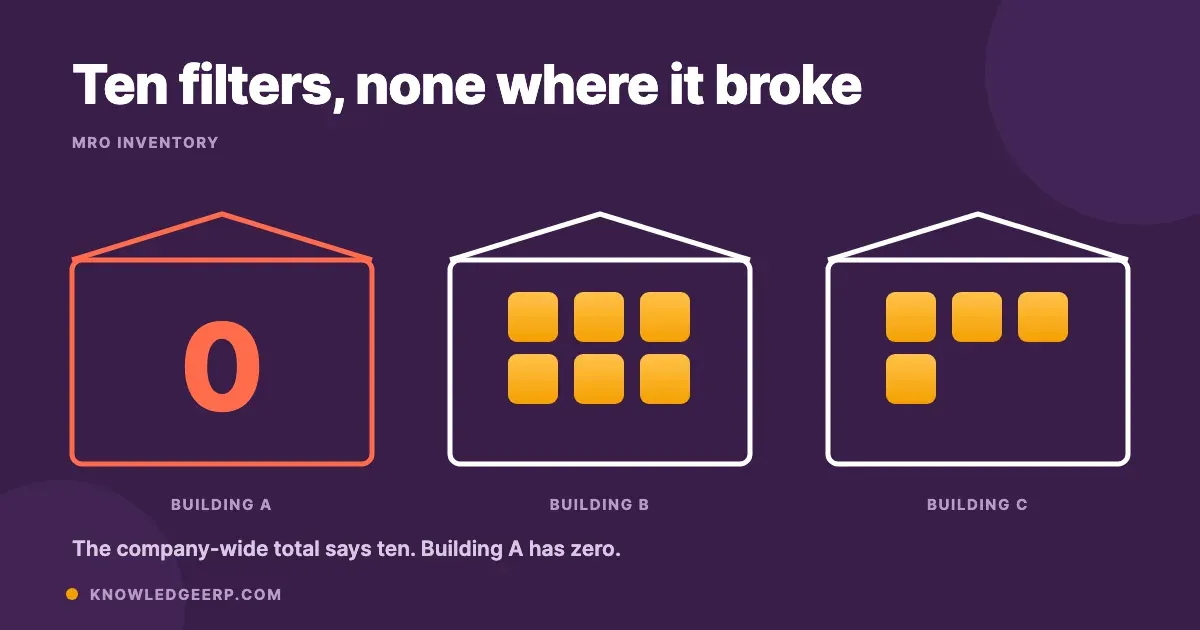
Ten filters spread across three buildings are not ten filters in the building that needs one tonight.
That is why a minimum stock level for maintenance parts should be set per location rather than for the whole organization. Building A might need to keep four on hand and the annex one, and the total tells you nothing about whether either of them is covered. A reorder point that only looks at the company-wide total will report that everything is fine while one building runs dry.
Moving stock between buildings should also be a recorded transfer, not a technician carrying a box across the parking lot. Otherwise one building's count goes wrong the moment the box leaves and the other's goes wrong when it arrives.
Tools are loans, not consumables
A filter gets used up. A torque wrench, a multimeter, a pipe threader or a lift comes back, or is supposed to.
Treating tools as stock with a quantity is how a department ends up owning six meters and being able to find two. They need to be checked out to a person with a date they are expected back, the same way any equipment loan should work. The due date is what makes an unreturned tool show up on a list instead of being noticed six months later.
Getting it under control
Do not start by cataloging every screw. That project takes months and loses momentum long before it is finished.
Start with the equipment that would hurt most if it stopped. List the parts those machines need that you would not want to wait for. Count those parts, record where they are, and set a minimum for each location that holds them. That short list is where nearly all of the risk sits, and you can have it done in a week.
Then widen it gradually, a storeroom or a system at a time, and put a checkout process in front of the tools.
Where Knowledge ERP fits, and where it does not
Knowledge ERP handles the stock side of maintenance. Parts are tracked across multiple Locations with bins inside each one, and users can be given a role at one Location without having it at all of them. Transfers between Locations are recorded with in-transit tracking. Reorder points are set for a specific Location, and low stock shows up in a reorder queue, as alerts, and in an optional digest email. Custom fields on products give you somewhere to record what a part fits and how critical it is.
Tools can be checked out to a person with a due date and a captured signature, and each Location can set its own default checkout period so the due date fills itself in.
What it does not do is schedule preventive maintenance or manage work requests. That is the job of a CMMS (computerized maintenance management system). If you already run one, Knowledge ERP would be the stockroom behind it, not a replacement for it. If your problem is mainly that nobody can find the parts or the tools, the stockroom is the place to start.
Keep the stockroom behind your maintenance team
Parts by Location and bin, minimums per Location, and tools checked out to a person. The trial runs 30 days on your real data.