
ERP stands for enterprise resource planning, which is a phrase invented for companies with a resource planning department. That is most of the problem with the category right when a small business goes looking at it.
Underneath the name it is a simple idea. An ERP is one system where your stock, your orders and your customers live together, so that selling something takes it out of inventory without anyone retyping it. That is the whole promise. Everything else is which parts of your business you connect to it.
Why the demos feel wrong
Search for ERP and you land on systems built for companies with a thousand staff, several currencies and a finance team to run them. They are good systems. They are also priced and shaped for that buyer, and the version that gets sold to a twelve-person business is usually the same software with a smaller number on it and a six-month implementation attached.
The result is a familiar shape of regret: a large annual commitment, a consultant, a configuration project, and a system where the eight things your business does are buried under two hundred things it does not.
Start from what breaks, not from the feature list
The honest way to size this is to write down where information currently gets retyped or lost. Not what you would like to automate one day. What breaks now.
For most small businesses that list is short. Stock counts wrong often enough that people check the shelf instead of the system. Orders that live in an inbox. A customer asking where their thing is and three people having to be asked. Something bought twice because nobody could see it was already on a shelf in the other building. A count nobody has verified since spring.
The list looks different depending on the operation. A trades business writes down vans and job sites. A nonprofit writes down proving where donated goods went rather than what they cost, which is a reporting problem more than a stock one. The exercise is the same either way.
Every item on that list points at a specific capability. Nothing on it requires a general ledger, multi-currency consolidation or demand forecasting, and if a vendor's answer to your five problems is a platform with sixty modules, you are being sold the wrong size of thing.
Buy the parts you have a problem with
This is why Knowledge ERP is built as separate modules rather than one system you switch on.
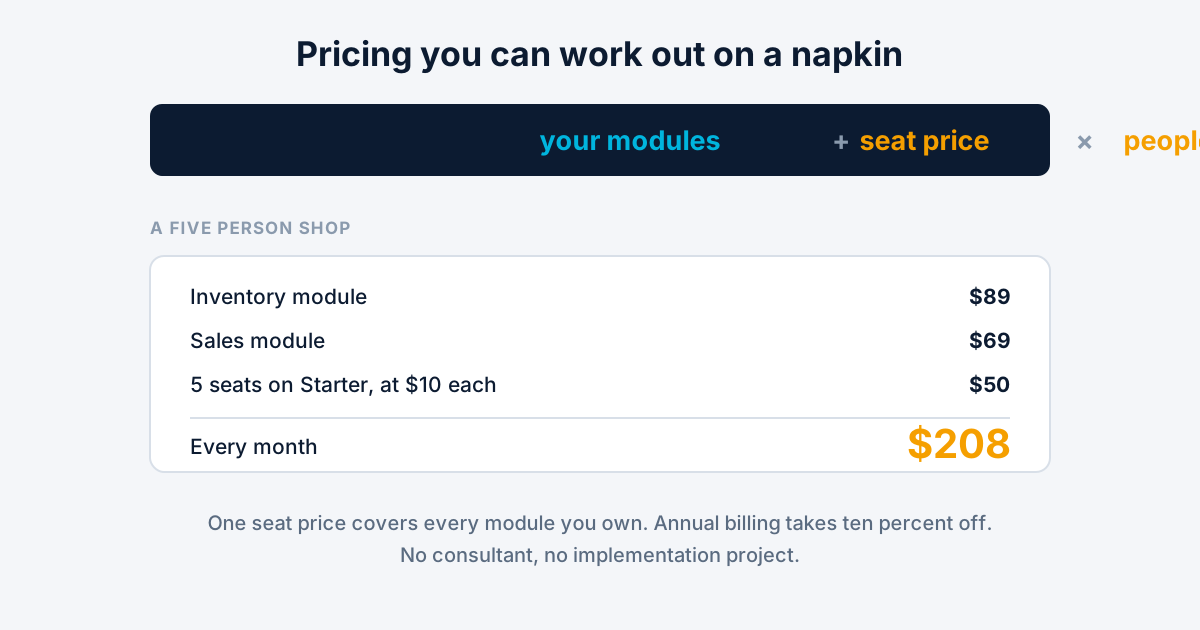
Inventory is $89 a month and covers products, individual units, locations and bins, lot and serial tracking, reorder points, transfers, cycle counts, kits, equipment loans and barcodes. Sales is $69 and covers quotes, sales orders, invoicing, payments, returns, recurring invoices, a customer portal and a CRM pipeline. Appointments is $39 for public booking pages, appointment types, questionnaires and reschedule requests. Surveys is $39 for surveys that go out automatically when something happens and report on what comes back.
Purchasing, Manufacturing and Rentals are built and not released yet, so they are marked as available soon rather than sold to you now.
Seats are separate, and one seat price covers every module you own. Starter is $10 per seat for up to five seats and one location. Growth is $12 for up to 25 seats and three locations, and adds API access. Business is $15 for up to 50 seats and ten locations.
So the arithmetic is your modules added up, plus your seat price times your number of people. A solo operator running Inventory pays $99 a month. A five-person shop running Inventory and Sales pays $208. Annual billing takes ten percent off.
You can work that out before talking to anyone, which is the point.
What it is not
It is not an accounting system. There is no general ledger in that module list and you will still have accounting software. What an ERP does is stop your operations and your books disagreeing about what happened, by being the place where what happened is recorded once.
It is also not a five-minute setup. Any system that becomes the source of truth for your stock needs your product data imported and your locations described, and that is real work, measured in days rather than months. Products import from CSV, so the spreadsheet you are running on now is the starting point.
How to test it without committing
The trial runs 30 days on your real data, and a card is only charged when the trial ends.
Thirty days is enough to answer the only question that matters, which is whether the numbers in the system stay true once actual work is flowing through it. Import your products. Put barcodes on one shelf or one van. Run a week of real orders through it and count that shelf at the end.
If the count matches, you have your answer. If it does not, you have found out something useful about your process for the price of a month of attention, and you can cancel.
Work out your own number
Modules added up, plus seats. No consultant, no implementation project, and a card that is only charged when the 30 days are up.