
Once a year, a lot of businesses stop. Nobody ships, nobody receives, and everyone walks the shelves with a clipboard counting things they do not normally think about. It takes a day or two, it costs whatever a day of not trading costs, and the numbers come out wrong anyway, because people counting unfamiliar stock under time pressure make mistakes, and because a count is a snapshot of something that moves.
Cycle counting is the alternative. Instead of counting everything once, you count a small slice every day and never stop. The shelves get counted at least as often, the doors stay open, and the counting is done by people who handle that stock all the time.
The part that makes it work
The instinct is to divide the catalog by the number of working days and count an equal slice each day. That beats an annual count and is still worse than it should be, because it spends the same attention on the item you sell 400 of a week as on the one you sold twice in 2024.
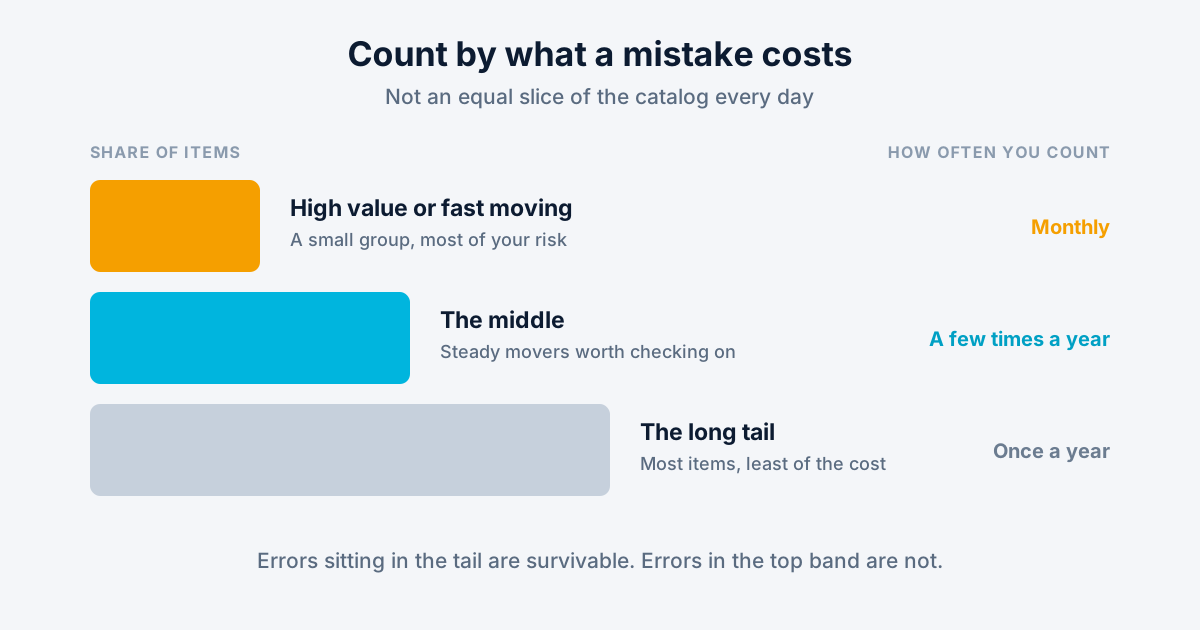
Sort by what a mistake costs instead. The usual split is three groups: a small group that is high value or high volume, a middle group, and a long tail. The first group gets counted often, perhaps monthly. The middle group a few times a year. The tail once a year, or whenever somebody touches it.
The exact proportions matter less than the principle. Count the things where being wrong hurts more often than the things where it does not.
Cycle counting methods
There are a handful of standard ways to decide what gets counted, and most operations mix two or three of them.
ABC cycle counting. Rank items by annual spend, then count the top group most often and the tail least. This is the three-group split above with a formal ranking behind it, and it is the most common method for good reason.
By location. Count one aisle, one room or one truck at a time until everything has been covered, then start again. It ignores value, but it is easy to schedule and nothing gets skipped.
Opportunity counts. Count a bin when it is nearly empty, because there is almost nothing to count. Some teams also count whenever a pick comes up short, since that is exactly when the record is suspect.
Control group. Pick a small set of items and count them repeatedly over a couple of weeks. The point is not those items. It is testing whether your counting process gives the same answer twice before you trust it with everything else.
Random sample. Count a random selection each day. Useful when an auditor wants a fair picture of overall accuracy, less useful for finding problems quickly.
Working out the schedule
Say you stock 1,000 items. You put 100 in the top group and count them monthly, 250 in the middle group and count them quarterly, and count the remaining 650 once a year.
That is 1,200 counts for the top group, 1,000 for the middle and 650 for the tail, or 2,850 counts a year. Spread across roughly 250 working days, it comes to between 11 and 12 items a day.
Eleven or twelve items is a short job for one person at the start of a shift. It is also a number you can check against, which matters more than it sounds. If a week goes by and nobody has counted 55 or 60 items, the program has stopped, whatever the schedule says.
The variance is the output, not the count
A cycle count that matches the record tells you almost nothing, because you expected it to match. A count that does not match is the entire point, and the useful question is not what is the right number but why did it drift.
Miscounted at receiving. Picked and not recorded. Damaged and binned without an adjustment. Taken by someone who meant to write it down later. Each of those is a different problem with a different fix, and correcting the number without identifying which one it was means you will be correcting the same number next quarter.
The pattern across your variances is worth more than any single corrected count.
A realistic accuracy target
Inventory record accuracy is usually measured as the share of counted records that matched: records within tolerance, divided by records counted. Count 200 items, find 194 that match the system, and your record accuracy is 97 percent.
"Within tolerance" does a lot of work in that sentence. For things you count one by one, the tolerance is normally zero. For things you weigh or measure, like a drum of oil or a spool of cable, a small allowance is reasonable, and it is worth writing down what that allowance is before the first count rather than after.
Perfect was never the target. Operations that take this seriously tend to land in the high nineties by unit and are right to be satisfied there.
The number that actually matters is not the headline percentage but where the errors are. Ninety eight percent accuracy across the catalog with the mistakes concentrated in your fastest movers is a worse position than ninety five percent with the mistakes sitting in the tail.
Blind counts
In a blind count, the person counting is not shown what the system expects. They record what they see, and the comparison happens afterward.
The reason is simple. If the sheet says 24 and there are 23 on the shelf, a tired counter will often write 24. Hiding the expected number removes that pull, at the cost of slower counts and more recounts. A common compromise is blind counts for the most valuable items and for anything that failed its last count, with the expected quantity shown everywhere else.
Keep it short or it will not survive
Cycle counting only lasts if each count is quick. Twenty minutes at the start of a shift happens every day. Two hours happens until the first busy week, and then it quietly stops.
In practice that means small batches, one location at a time, and a count sheet already sorted the way the shelves are physically arranged so nobody walks back and forth. It also means scanning rather than typing, because typing part numbers is where a good share of counting errors are born.
In Knowledge ERP
Knowledge ERP calls these stock counts, and they are part of the Inventory module. A count covers one Location, one bin, or every Location at once, and it creates a line for every unit in that scope with the quantity the system expects. The expected quantity is shown on each line, so these are not blind counts.
For things you count one by one, each line asks a simple question: is it on the shelf? For things you measure, it asks how much is left, in the product's own units. On the floor, scan mode lets you scan a bin and then each unit in it, and a scan plus one key records that the unit is there.
Because stock is tracked as individual units rather than a single quantity, a variance points at specific items rather than at a number. The movement log for those units shows every transfer, sale, loan and adjustment they have been through, and who did each one, which is usually enough to answer the why did it drift question without opening a separate investigation.
Finishing a count writes the differences as adjustment movements, so a corrected count becomes part of each unit's history rather than an overwrite of it. There is no built-in counting schedule. You decide what to count and when, which is where the methods above come in.
Where to start
Take your twenty highest value or fastest moving items and count them this week. Not the whole catalog, not a schedule, just those twenty.
Whatever variance you find on that list is the number worth reacting to, and it will tell you more than the annual count ever did. If those twenty currently live on a spreadsheet, that is fine for the first pass, and the exercise is the same.
Count one bin at a time
Stock counts, unit-level stock and a full movement log are part of the Inventory module. The trial runs 30 days on your real data.