
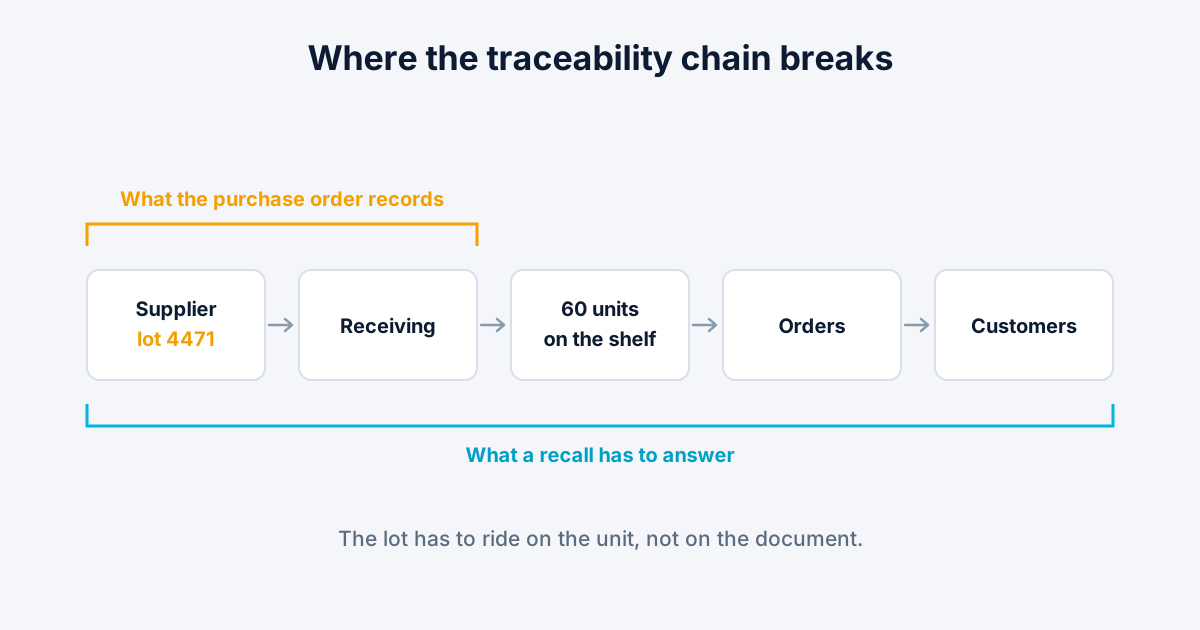
A recall is a deadline. Someone tells you a batch is bad, and the clock starts on two questions: which units came from that batch, and where are they now. If assembling that answer takes three days of paper receipts and memory, the recall costs you three days plus whatever the delay does to everyone downstream.
The uncomfortable part is that the work which makes a recall fast happens months earlier, at receiving, on an ordinary Tuesday when nothing is wrong.
This assumes you already have lot numbers to work with. If you are earlier than that, start with what a lot number is and how to read one.
One up, one back
The common expectation, and the one most food and medical regulators build on, is that you can answer two questions about anything you handle: who you got it from, and who you sent it to. One step up the chain, one step back down.
Check what your own industry and state actually require, because it varies and this is not legal advice. But one up, one back is a reasonable floor even where nothing forces it on you, because it is also the minimum that makes a recall survivable.
The trap is that most businesses can answer the first half and not the second. The purchase order says you bought lot 4471 from your supplier. Nothing says which of your customers ended up with it.
Where the chain usually breaks
Three places, and they all have the same root cause.
The lot is on the purchase order, not on the stock
You know the shipment contained lot 4471. You do not know which of the 60 units on the shelf came from it, because they all merged into one number when they were put away.
The lot is captured at receiving and dropped at picking
Someone records it carefully on the way in. On the way out the pick list says "6 x part 88-A" and nobody writes down which six.
Two lots share a bin
Even with good records at both ends, if lot 4471 and lot 4488 sit in the same bin with nothing to tell them apart physically, the record is a guess wearing a number.
All three come from the same mistake: the lot is attached to a document instead of to a thing.
What has to be true instead
The lot has to travel with the physical item, from arrival to departure, and every movement in between has to carry it.
That is what unit-level tracking is for. In Knowledge ERP a product is the catalog record and a unit is the specific physical item, and the lot number and expiry date live on the unit rather than on the paperwork. Transfers and loans record which units moved, with the person who did it and the time, and shipping records which lot left on which order.
So the recall query becomes a lookup instead of an investigation. Give it the lot and a report lists every unit that carried it and where each one is now, and for each one that shipped, the order and the customer it went to. Orders shipped through ShipStation show their units as "to confirm" until someone confirms which ones went.
Run a mock recall before you need a real one
Pick a lot you received a few months ago and time yourself finding every unit. Do not prepare. That number is your actual recall time.
Most people doing this the first time find the answer is not slow, it is unavailable. They can get close, and close is the problem, because a recall you cannot bound precisely turns into a recall of everything you might have shipped that quarter.
If the mock recall takes an hour and gives you a list you would stake the business on, you are fine and you can stop reading. If it takes a day and gives you a maybe, that gap is worth closing while you are the one choosing the deadline.
Turn it on where it pays
You do not need lot tracking on everything. Categories in Knowledge ERP carry tracking flags, so consumables nobody will ever recall stay simple, and anything with a batch, a shelf life or a warranty gets the full treatment. If a component ends up inside an assembled product, kitting records which lot went into each kit.
Start with the products where a recall would actually reach a customer. That is usually a much shorter list than the catalog, and it is the list the clock will be running on.
Run the mock recall again in a month
The 30-day trial runs on your real data. Import your products, turn lot tracking on for one category, and time it.