
Kitting is combining several separate items into one thing you sell, store or ship as a unit. A gift basket. A starter kit. A repair kit with the gasket, the two bolts and the tube of sealant. Three products bundled for a promotion. The parts exist separately in your warehouse, and the kit is what the customer orders.
That is the whole definition of inventory kitting. What it does to your stock count is the part worth reading about.
Kitting, assembly and bundling are not the same thing
The three words get used interchangeably, and the difference starts to matter the moment you try to track them.
Kitting puts finished items together without changing them. Every part in a first aid kit could be sold on its own, and a customer who took the kit apart would get exactly those parts back.
Assembly turns components into something new. Once a circuit board, a housing and four screws become a controller, you cannot sell the screws anymore. That is a manufacturing step, with a bill of materials, labor and usually a work order.
Bundling is mostly a pricing decision. A camera sold with a discounted bag may never be packed together at all. The items ship side by side and the discount lives on the invoice.
Kitting and assembly are often done at the same bench by the same people, which is why contract warehouses so often sell them as one service. For inventory purposes, keep them apart. A kit can always be traced back to parts you still recognize. An assembled product cannot.
The counting problem
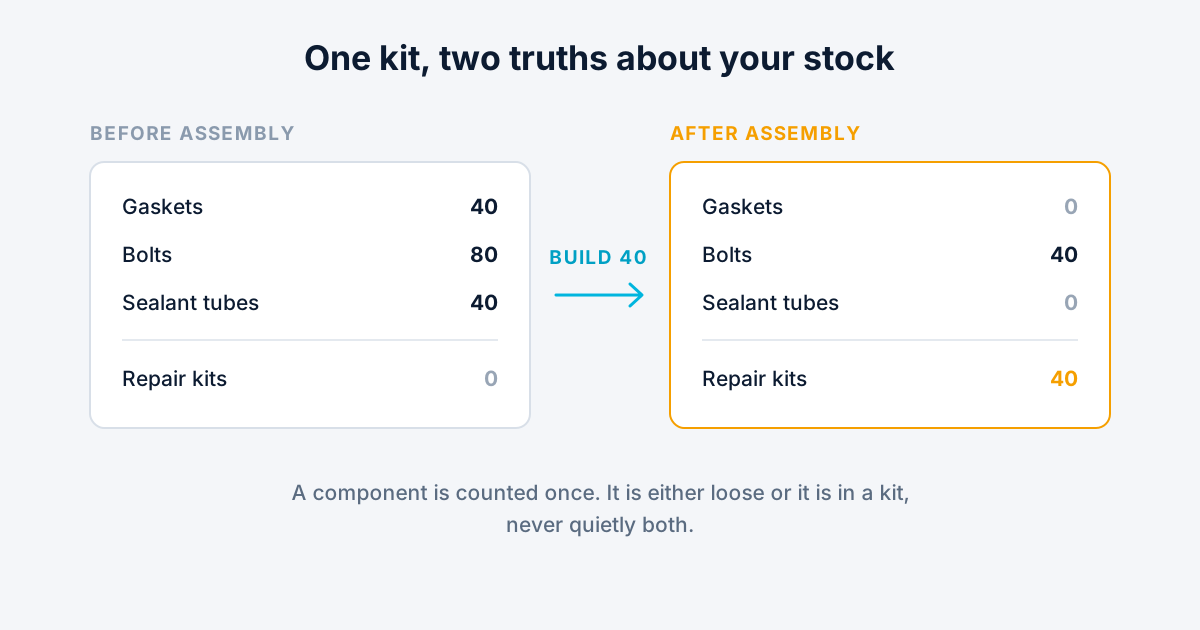
A kit exists twice. Before assembly it is six components on six shelves. After assembly it is one thing in one place. Both are true at different times, and your stock count has to survive the transition.
Get it wrong in one direction and you oversell components you already consumed into kits. Get it wrong in the other and you have 40 built kits that the system still believes are loose parts, so it cheerfully promises those parts to somebody else.
The usual workaround is to keep kits out of the system entirely and assemble them by hand when an order arrives. That works at low volume. It stops working the first time you promise a kit you cannot build, because someone used the last gasket on a repair.
Two ways to run kits
They have different failure modes, and most operations end up doing both.
Assembled ahead
You build 50 kits on Monday. The components come out of stock, the kits go in, and from then on the kit is a real thing with its own location and its own count. This suits predictable demand and fast shipping. The cost is committed inventory: those components are kits now, whether or not anyone wants kits this month.
Assembled on demand
The kit exists as a definition rather than as stock. When an order comes in the system checks that every component is available, and the kit is built at pick time. Nothing is committed early. The cost is that availability becomes a calculation across every component, and the scarcest one sets what you can promise.
Ahead for the sellers, on demand for the long tail, is where most people land. Whichever you pick, the thing that has to hold is that a component is counted once. It is either loose or it is in a kit, never quietly both.
What kitting looks like in a warehouse
Warehouse kitting usually happens at a fixed station, close to where the components are stored and close to packing. Someone picks every part for a batch of kits, builds them, labels them, and either puts them away or sends them straight to shipping.
A few details decide whether that station speeds things up or becomes the bottleneck.
Count the packaging. The box, the insert and the printed card are components too. Leave them out of the kit definition and you run out of boxes while the system shows plenty of kits you could build.
Give the picker parts, not kits. A pick list that says "40 of kit A" leaves the multiplication to the person holding the cart. One that lists 40 cases, 80 bits and 40 drills does not.
Label the finished kit. If a built kit has no barcode of its own, the next person has to open it to find out what it is.
Build to a number you can defend. Building 200 kits because the station happens to be free this week turns 200 sets of components into stock nobody may order.
Where it gets harder
Kits inherit every complication their components have.
If a component is lot tracked, the kit has to record which lot went into which kit, or the traceability chain stops dead at the assembly bench. Same for a serialized component: a kit containing a serialized controller board should be able to tell you which board.
Disassembly needs to work too. Returns come back as kits and often get broken down, and stock that cannot be un-kitted accumulates as a discrepancy nobody can explain six months later.
How Knowledge ERP handles it
Kits are part of the Inventory module. A kit is a named bundle of products, or of other kits, with the amount of each component it needs. Defining a kit does not consume anything. The components stay ordinary stock until the kit is actually sold, loaned or rented.
That makes it an assemble-on-demand approach. Each kit shows an estimated stock figure: how many complete kits the components currently in stock could make, set by whichever component runs out first. Units that are checked out, on hold or in transit do not count toward it.
When a kit goes on a sales order, availability and reservation expand it into its components, and shipping it ships the right number of each. If one component is short, the order shows a shortage for that component, the same as it would for a single product. A kit on a loan or a rental holds its components for the dates of the agreement, so they come off everyone else's availability for those dates.
Because the components are individually tracked units, the lot and serial numbers on the units that shipped go out with them, exactly as they would if each part had been sold on its own. A kit can also carry its own barcode for labels.
Kits you build ahead are handled differently, on purpose. A kit put together in advance and stored as one sealed item is really a finished product, so Knowledge ERP treats it as one: a composite product with a bill of materials, built by a work order that uses up the parts and puts the finished units on the shelf. That is the Manufacturing module, which is coming soon. Until it ships, kits cover the approach where parts are picked together when the order goes out.
When it is worth the complexity
Kitting earns its keep when you sell a combination often enough that hand assembly is a bottleneck, when the combination has to stay traceable, or when you keep promising bundles you cannot build.
If you sell four gift sets in December and nothing else all year, keep doing it by hand.
Find out whether you actually need kits
The 30-day trial is long enough to define your real kits and watch what a month of orders does to the component counts.